


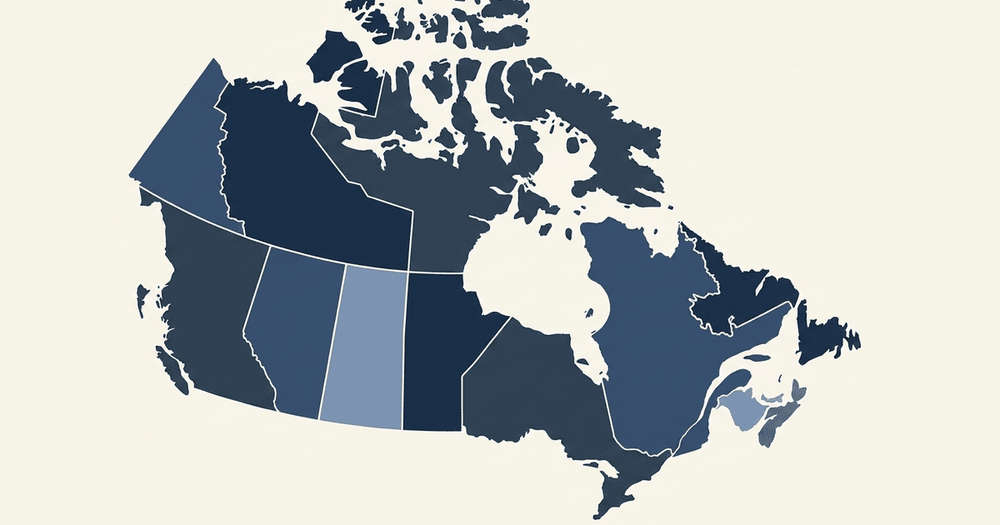


Ask what Canada's average credit score is and you get a number from a fintech, never from a bureau, because neither Equifax nor TransUnion publishes one. Application data offers a different and checkable view: what people report about their credit at the moment they apply, province by province. This report covers the year to July 2026, drawn from more than 40,000 Smarter Loans personal loan applications.
The bands, province by province
| great | good | fair | low | no credit or unsure | |
|---|---|---|---|---|---|
| Ontario | 1.8% | 13.3% | 50.6% | 27.3% | 6.2% |
| Alberta | 1.3% | 11.1% | 49.7% | 30.5% | 7.0% |
| British Columbia | n/a | 12.9% | 50.1% | 28.3% | 6.4% |
| Quebec | n/a | 10.8% | 37.7% | 35.7% | 10.8% |
| Manitoba | n/a | 10.0% | 39.3% | 34.8% | 13.8% |
| Saskatchewan | n/a | 8.0% | 35.6% | 42.0% | 12.5% |
| New Brunswick | n/a | n/a | 40.3% | 40.7% | 10.7% |
| Nova Scotia | n/a | n/a | 44.9% | 36.8% | 9.2% |
Source: Smarter Loans personal loan applications, August 2025 to July 2026.
Applications by province: Ontario 17,850; Alberta 8,463; British Columbia 5,211; Quebec 2,602; Manitoba 1,764; Saskatchewan 1,379; New Brunswick 1,266; Nova Scotia 1,215. n/a marks fewer than 100 applications in that band.
Newfoundland and Labrador, Prince Edward Island, Northwest Territories and Yukon had too few applications in most bands to publish a full row. Cells marked n/a had fewer than one hundred applications.
What the pattern shows
- Fair credit leads almost everywhere. Around half of applicants in Ontario, Alberta and British Columbia, and between a third and a half elsewhere.
- Two provinces invert it. Saskatchewan is the clear case, with 42.0 percent reporting low credit against 35.6 percent fair. New Brunswick is a near tie the other way, at 40.7 against 40.3. Everywhere else fair leads by eight points or more.
- Good and great are small in every province. Fewer than one in seven applicants combined, everywhere. People with strong credit borrow from their bank; they rarely arrive at a comparison platform.
- Provinces cluster more than they differ. The gap between Ontario's fair share and Quebec's is thirteen points; the gap between fair and low inside Quebec is two. Band predicts a borrower far better than province does.
- No credit or unsure is real, six to fourteen percent by province, highest where populations are youngest and most mobile.
What the bands mean in dollars
View as table
| Under 560 | $5,529 |
| 560 to 659 | $6,866 |
| 660 to 724 | $10,227 |
| 725 and above | n/a |
Source: Smarter Loans personal loan applications, August 2025 to July 2026.
n/a marks fewer than 100 applications.
Band is not an abstraction. Across Smarter Loans personal loan applications from August 2025 to July 2026, the average debt consolidation request rose from $5,529 below a 560 score to $10,227 in the 660 to 724 band, because better credit opens larger loans at rates that make consolidating more of a debt load worthwhile. The same gradient runs through every product: the band a borrower reports shapes what they ask for before it shapes what they are offered.
Why applicants are not the whole population
This is application data. People with excellent credit mostly borrow from their own bank and never apply through a platform, so they are under-represented here; people with fair or low credit are over-represented for the same reason. Read the table as a picture of who is actively seeking credit, not as a census. It is a narrower claim than a national average, and unlike a national average it can be checked.
What this means if you are borrowing
If you are in the fair band, you are the typical applicant and lenders underwrite your file every day. If you are in the low band, you are the second largest group and the online market is priced for you. Our guides to whether 700 is a good credit score and how to rebuild credit in Canada cover what each band gets and how to move up one, and the credit building loans page compares lenders that serve every band on that table.
Frequently asked questions
What is the average credit score in Canada?
No bureau publishes one. Among loan applicants, fair credit, roughly 560 to 659, is the largest self-reported group in almost every province.
Which province has the best credit?
Among Smarter Loans applicants in the year to July 2026, Ontario and British Columbia had the largest share reporting good or great credit, but the difference from other provinces is a few points, not a different picture.
Which province has the worst credit?
Saskatchewan, where 42.0 percent reported low credit against 35.6 percent fair. New Brunswick is close to even at 40.7 against 40.3. Every other reportable province has fair ahead of low.
Does credit band affect how much you can borrow?
Sharply. Across Smarter Loans personal loan applications from August 2025 to July 2026, consolidation requests rose from $5,529 below a 560 score to $10,227 in the 660 to 724 band.
About this data
Figures are drawn from Smarter Loans personal loan applications between August 1, 2025 and July 31, 2026. Credit band is self-reported at application. Provinces are shown only where at least three bands hold 100 or more applications; Nunavut is excluded on a data-quality flag. The consolidation figures use the TransUnion score recorded at application, a different measure from the self-reported band. Smarter Loans has connected more than 2 million Canadians with financing since 2016. Our other reports from the same application data are collected at Smarter Loans Research.
 Written by:
The Smarter Loans Editorial Team produces in-depth, original content to help Canadians navigate borrowing, credit, and personal finance with confidence.