




On this page
What a HELOC actually is
A home equity line of credit is a revolving facility secured against your property. You are approved for a limit, you draw what you need, and you pay interest only on the outstanding balance. The rate is variable, moving with your lender's prime, and most HELOCs allow interest-only payments, which keeps the minimum low and the principal exactly where it was. That combination is why the product is so flexible and so easy to carry indefinitely.
The security is the important part. An unsecured line that goes wrong damages your credit. A home equity facility that goes wrong puts the house in the conversation. Every strategy below is priced on that, and none of them changes it.
How much you can borrow
Lenders generally allow a HELOC up to 65 percent of your home's value, and your total secured borrowing including the mortgage up to 80 percent. On a $700,000 home with $350,000 owing, that means roughly $210,000 of room, subject to income and credit like any other approval.
The amounts involved are substantial. Across Smarter Loans home equity applications from August 2025 to July 2026, the average amount requested was $45,082. That is a different order from unsecured borrowing, and it is the reason the decisions on this page deserve more thought than a personal loan does.
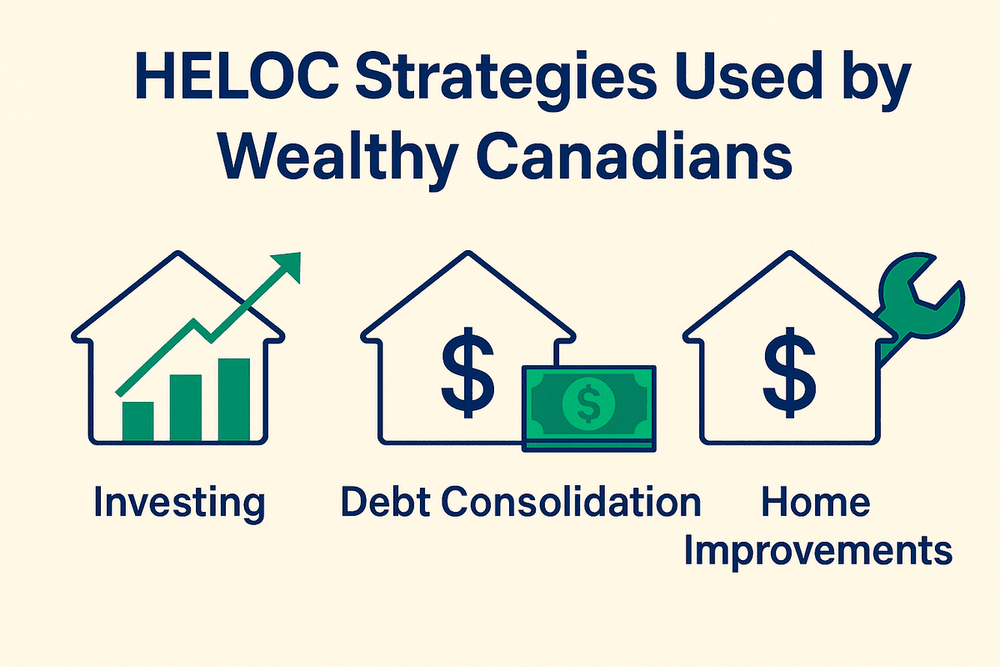
Replacing higher-interest debt
The clearest use, and the one with the least speculation in it. Card balances at twenty percent and up replaced by secured borrowing in the single digits saves real money from the first month, and the arithmetic is not in doubt.
Illustrative only. Figures show relative scale, not measured values.
Two conditions make it work. The cards have to stay down afterwards, because a HELOC that clears them and then sits alongside refilled balances has doubled your borrowing rather than reduced it. And you need a repayment plan beyond the interest-only minimum, or the balance never falls. Our guide to debt consolidation in Canada covers the failure mode in detail; it applies here with the house attached.
Funding a property down payment
Drawing on equity in one property to fund the down payment on another is standard practice among Canadian landlords. The appeal is obvious: the equity is otherwise idle, and a rental generates income against the cost of the draw.
Illustrative only. Figures show relative scale, not measured values.
What makes it work or fail is whether the rental covers the full carrying cost with room to spare, counting the HELOC interest, the new mortgage, taxes, insurance, maintenance and vacancy. Run it at a realistic vacancy rate rather than full occupancy, and run it at a higher prime than today's. A property that only works at current rates and full occupancy is not an investment, it is a bet on two things staying still.
The risk is concentration. Both properties are now exposed to the same housing market and the same rate environment, and the first one is securing the second.
Borrowing to invest, honestly
Borrowing against a home to buy investments is legal, common, and the strategy on this page most often described without its downside. When the investment return exceeds the borrowing cost, the spread is yours. When it does not, you owe the balance regardless of what the portfolio did, and the interest accrues on a schedule the market does not respect.
Illustrative only. Figures show relative scale, not measured values.
In Canada the interest on money borrowed to earn investment income is generally tax deductible, which is the mechanism behind what is often called the Smith Manoeuvre: converting non-deductible mortgage interest into deductible investment loan interest over time. The deductibility rules are specific about how funds are traced and what counts as income earning, and getting the structure wrong loses the deduction while keeping the debt. This is the one strategy here where professional advice is not optional, and where you want it before the first draw rather than at tax time.
Two honest cautions from the mechanics. The borrowing rate is variable and the return is not guaranteed, so the spread you model today can invert. And a market fall does not reduce the balance, which is what makes a leveraged loss different in kind from an unleveraged one.
Holding an unused facility
The quietest use, and arguably the strongest. A HELOC arranged while your income and credit are strong, and then left undrawn, costs nothing but the setup and gives you access to funds on a day when a lender might not approve you. It is the cheapest emergency liquidity available to a homeowner.
Illustrative only. Figures show relative scale, not measured values.
The discipline is not to treat available credit as available money. The facility earns its place by being there for a genuine emergency, not by funding the expenses an emergency fund should cover.
Funding renovations
Renovations are the use HELOCs were originally sold for, and above roughly ten thousand dollars the secured rate usually beats an unsecured loan by enough to justify the appraisal and the paperwork. Below that, an unsecured loan is faster and keeps the house out of it. Our guide to using a personal loan for renovations covers where the line sits.
Illustrative only. Figures show relative scale, not measured values.
One caution specific to renovations on a line of credit: draw against quotes, not against the limit. The limit is what the lender will allow, not what the project costs, and the gap between those two numbers is where renovation budgets go wrong.
What every one of these shares
Three things are true of all six approaches and worth stating plainly.
- The rate is variable. Every strategy modelled at today's prime should also be modelled two points higher. If it only works at the current rate, it does not work.
- Interest-only payments hide the balance. A facility carried at the minimum for years costs a great deal and reduces nothing. Decide the repayment schedule when you draw, not later.
- The security is your home. Default on an unsecured loan and you have a credit problem. Default here and you have a housing problem. That is the whole difference, and it is why none of these strategies belongs to someone whose income is uncertain.
Illustrative only. Figures show relative scale, not measured values.
| Lender | Amount | Rate | Speed | |
|---|---|---|---|---|
| 8Twelve Mortgage | $50,000 to $10,000,000 | 4.09% APR | about 7 business days | See if you qualify |
| Spring Mortgages | $25,000 to $1,000,000 | 5% APR | about 7 business days | See if you qualify |
| Lotly | $15,000 to $10,000,000 | 6 to 16% APR | about 7 business days | See if you qualify |
| Nuborrow | $20,000 to $100,000,000 | 4.99% APR | about 2 business days | See if you qualify |
| Canadalend.com | $20,000 to $10,000,000 | 4.99% APR | about 7 business days | See if you qualify |
| Bloom Finance Company | $20,000 to $2,000,000 | 4 to 5% APR | about 7 business days | See if you qualify |
| Homewise | $50,000 to $10,000,000 | 4.99% APR | about 7 business days | See if you qualify |
One application compares what lenders will advance against your equity and on what terms.
Frequently asked questions
How much can you borrow on a HELOC in Canada?
Generally up to 65 percent of your home's value on the line itself, and up to 80 percent when the mortgage and the HELOC are counted together. Income, credit and the property's appraised value all constrain the final number below that ceiling.
Is it a good idea to use a HELOC to invest?
It works when the return exceeds the borrowing cost and you can carry the payment if it does not. The interest is generally tax deductible when the borrowed money earns investment income, which improves the arithmetic, but the rules on tracing funds are specific enough that this is a conversation to have with an accountant before you draw rather than after.
What happens if you cannot pay your HELOC?
The lender can demand repayment and ultimately move against the property, because the line is secured by it. Most lenders can also reduce or freeze the limit at their discretion, including on facilities that are performing, which is worth knowing before you rely on one as a backstop.
Is a HELOC better than refinancing?
A HELOC keeps your existing mortgage and its rate intact, which matters when the current mortgage is cheaper than today's market. Refinancing replaces the whole mortgage and can be simpler if the rate improves. The right answer depends entirely on what rate your existing mortgage carries.
Sources
- Financial Consumer Agency of Canada, Borrowing against home equity, for both limits: a HELOC up to 65 percent of the home's value, and up to 80 percent borrowed against home equity in total. Verified 2 September 2026.
- Canada Revenue Agency, Line 22100, carrying charges and interest expenses, which allows interest paid to earn income from investments. Verified 2 September 2026.
- Smarter Loans home equity applications, August 2025 to July 2026, for the average amount requested.
Related reading: mortgages versus home equity loans and debt consolidation in Canada.
 Written by:
The Smarter Loans Editorial Team produces in-depth, original content to help Canadians navigate borrowing, credit, and personal finance with confidence.